DarkSteven
Posts: 28072
Joined: 5/2/2008
Status: offline

|
quote:
ORIGINAL: Real0ne
you sure?
also from wiki:
Chemical toxicity
The chemical toxicity of depleted uranium is about a million times greater in vitro than its radiological hazard.[73] Health effects of DU are determined by factors such as the extent of exposure and whether it was internal or external. Three main pathways exist by which internalization of uranium may occur: inhalation, ingestion, and embedded fragments or shrapnel contamination. Properties such as phase (e.g. particulate or gaseous), oxidation state (e.g. metallic or ceramic), and the solubility of uranium and its compounds influence their absorption, distribution, translocation, elimination and the resulting toxicity. For example, metallic uranium is less toxic compared to hexavalent uranium(VI) uranyl compounds such as uranium trioxide.[74][75]
Radiological hazards
The primary radiation danger from depleted uranium is due to alpha particles, which do not travel far through air, and do not penetrate clothing. Thus, the primary concern is internal exposure, due to inhalation, ingestion or shrapnel contamination. Available evidence suggests that this risk is small relative to the chemical hazard.[73]
According to the World Health Organization, a radiation dose from it would be about 60% of that from purified natural uranium with the same mass; the radiological dangers are lower due to its longer half-life and the removal of the more radioactive isotopes. However, in a matter of a month or so, depleted uranium generates amounts of thorium-234 and protactinium-234 which emit beta particles at almost the same rate as that of the alpha particles from the uranium-238.
Increased rates of immune system disorders and other wide-ranging symptoms, including chronic pain, fatigue and memory loss, have been reported in over one quarter of combat veterans of the 1991 Gulf War.[88] Combustion products from depleted uranium munitions are being considered as one of the potential causes by the Research Advisory Committee on Gulf War Veterans' Illnesses, as DU was used in 30 mm and smaller caliber machine-gun bullets on a large scale for the first time in the Gulf War. Veterans of the conflicts in the Persian Gulf, Bosnia and Kosovo have been found to have up to 14 times the usual level of chromosome abnormalities in their genes.[89][90] Serum-soluble genotoxic teratogens produce congenital disorders, and in white blood cells causes immune system damage.[91]
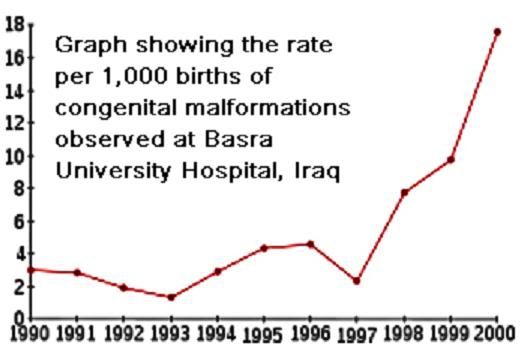
Human epidemiological evidence is consistent with increased risk of birth defects in the offspring of persons exposed to DU.[10] A 2001 study of 15,000 February 1991 U.S. Gulf War combat veterans and 15,000 control veterans found that the Gulf War veterans were 1.8 (fathers) to 2.8 (mothers) times more likely to have children with birth defects.[92] After examination of children's medical records two years later, the birth defect rate increased by more than 20%:
"Dr. Kang found that male Gulf War veterans reported having infants with likely birth defects at twice the rate of non-veterans. Furthermore, female Gulf War veterans were almost three times more likely to report children with birth defects than their non-Gulf counterparts. The numbers changed somewhat with medical records verification. However, Dr. Kang and his colleagues concluded that the risk of birth defects in children of deployed male veterans still was about 2.2 times that of non-deployed veterans."[93]
In early 2004, the UK Pensions Appeal Tribunal Service attributed birth defect claims from a February 1991 Gulf War combat veteran to depleted uranium poisoning.[94][95] Children of British soldiers who fought in wars in which depleted uranium ammunition was used are at greater risk of suffering genetic diseases such as congenital malformations, commonly called "birth defects," passed on by their fathers. In a study of U.K. troops, "Overall, the risk of any malformation among pregnancies reported by men was 50% higher in Gulf War Veterans (GWV) compared with Non-GWVs."[96]
The chemical toxicity of depleted uranium is about a million times greater in vitro than its radiological hazard
Pretty much agrees with what I said about the radiological hazard being essentially nil.
Radiological hazards
The primary radiation danger from depleted uranium is due to alpha particles, which do not travel far through air, and do not penetrate clothing. Thus, the primary concern is internal exposure, due to inhalation, ingestion or shrapnel contamination. Available evidence suggests that this risk is small relative to the chemical hazard.
While technically correct, this omits to mention the fact that the pathways exist for the chemical as well as radiological impact. Plain and simple, the chemical pathway is the only one of concern.
However, in a matter of a month or so, depleted uranium generates amounts of thorium-234 and protactinium-234 which emit beta particles at almost the same rate as that of the alpha particles from the uranium-238.
Horribly written and completely misleading. With a DU half life of some 700 million years, the "amounts" of Th-234 and Pa-234 generated will be inconsequential.
Increased rates of immune system disorders and other wide-ranging symptoms, including chronic pain, fatigue and memory loss, have been reported in over one quarter of combat veterans of the 1991 Gulf War.[88] Combustion products from depleted uranium munitions are being considered as one of the potential causes by the Research Advisory Committee on Gulf War Veterans' Illnesses, as DU was used in 30 mm and smaller caliber machine-gun bullets on a large scale for the first time in the Gulf War. Veterans of the conflicts in the Persian Gulf, Bosnia and Kosovo have been found to have up to 14 times the usual level of chromosome abnormalities in their genes.[89][90] Serum-soluble genotoxic teratogens produce congenital disorders, and in white blood cells causes immune system damage.[91]
Human epidemiological evidence is consistent with increased risk of birth defects in the offspring of persons exposed to DU.[10] A 2001 study of 15,000 February 1991 U.S. Gulf War combat veterans and 15,000 control veterans found that the Gulf War veterans were 1.8 (fathers) to 2.8 (mothers) times more likely to have children with birth defects.[92] After examination of children's medical records two years later, the birth defect rate increased by more than 20%:
"Dr. Kang found that male Gulf War veterans reported having infants with likely birth defects at twice the rate of non-veterans. Furthermore, female Gulf War veterans were almost three times more likely to report children with birth defects than their non-Gulf counterparts. The numbers changed somewhat with medical records verification. However, Dr. Kang and his colleagues concluded that the risk of birth defects in children of deployed male veterans still was about 2.2 times that of non-deployed veterans."
Again, horribly written and misleading. Makes the claim that the symptoms appeared in veterans exposed to DU, without mentioning that the veterans were exposed to other things as well.
The final claim is that a SINGLE claim of Gulf War syndrome was connected to DU. Again, horrible science, and there is n question that a single case doesn't merit a study with thousands of veterans to choose from.
_____________________________
"You women....
The small-breasted ones want larger breasts. The large-breasted ones want smaller ones. The straight-haired ones curl their hair, and the curly-haired ones straighten theirs...
Quit fretting. We men love you."
|

 RE: Rumsfeld: Bush should get credit for bin Laden's de... -

 Profile



 New Messages
 No New Messages
 Hot Topic w/ New Messages
 Hot Topic w/o New Messages
 Locked w/ New Messages
 Locked w/o New Messages
 Post New Thread